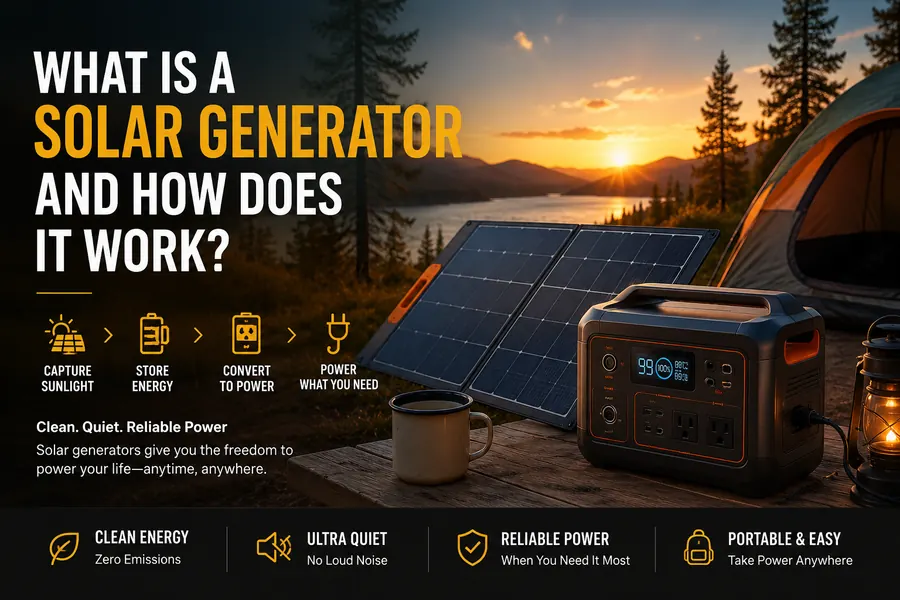
A solar generator is not an engine. It is a battery, an inverter, a charge controller and a set of outlets packaged in one portable unit. Add solar panels and you have a quiet, fuel-free power source that recharges from the sun.
The four parts inside
Every solar generator is built from the same building blocks:
- Battery: usually LiFePO4 today, rated in watt hours (Wh) of stored energy
- Inverter: converts DC battery power into household AC, rated in watts of output
- Charge controller: manages charging from solar panels, a wall outlet or a vehicle
- Outlets and ports: AC outlets, USB-C, 12V car sockets and sometimes 30A RV plugs
Reading the two big numbers
Capacity (Wh) tells you how long you can run something. A 1,000Wh unit runs a 100W refrigerator for roughly 8–9 hours after inverter losses. Output (W) tells you what you can run at once. A 2,000W inverter handles a microwave or a small space heater; a 300W unit does not.
Expandable systems
Many modern units accept expansion batteries that plug in to multiply capacity, and some support parallel operation for 240V split phase output. That lets you start with a small system for camping and grow into whole home backup later.
Is a solar generator right for you?
If you want plug-and-play power with no installation, a solar generator is the easiest path. If you need to power a whole house for days, a dedicated inverter with rack batteries is usually more cost effective. Our Power Planner and support team can help you decide.