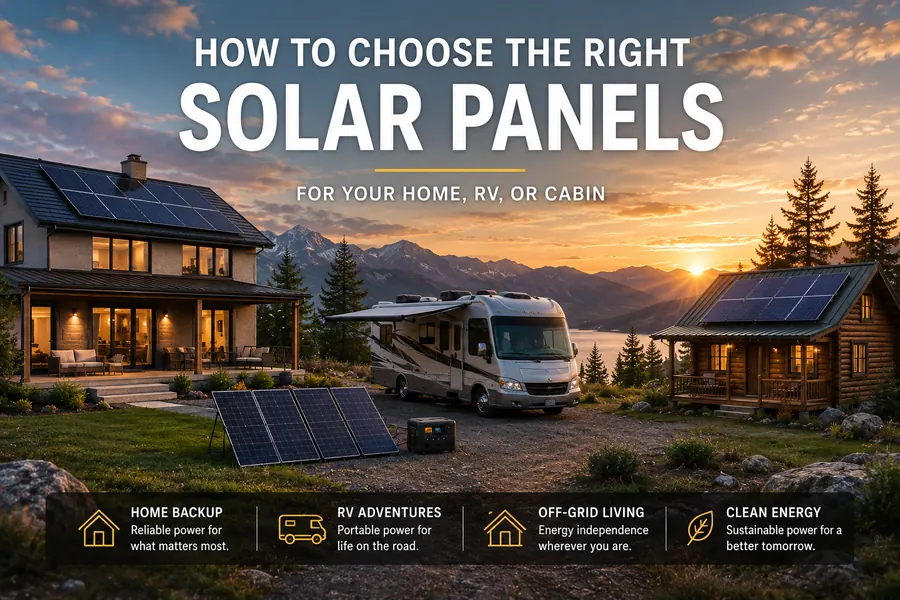
Solar panels come in many shapes, sizes and price points. The right choice depends on where they will live, how much energy you need each day, and what they will connect to. This guide covers the four decisions that matter most.
1. Rigid, portable, bifacial or flexible?
Each panel construction fits a different installation:
- Rigid glass panels: best value per watt, ideal for rooftops and ground mounts
- Portable folding panels and suitcases: fast setup for camping and power stations
- Bifacial panels: collect reflected light from the back side, great on ground mounts and light surfaces
- Flexible panels: lightweight and low profile for curved RV and boat roofs
2. How many watts do you need?
Take your daily energy use in watt hours and divide by your local peak sun hours (typically 4 to 5.5). Then add about 20% for wiring, temperature and charging losses. A cabin using 3,000Wh per day in a 4.5 sun-hour region needs roughly 800W of panels.
3. Match voltage to your controller or power station
Every charge controller and power station has a maximum input voltage and current. Panel open-circuit voltage rises in cold weather, so leave headroom. Wiring panels in series adds voltage; wiring in parallel adds current. Our series vs parallel guide explains the trade-offs.
4. Plan mounting, cables and connectors
Budget for brackets or tilt mounts, properly sized extension cables and MC4 connectors. Long cable runs at low voltage lose power, which is another reason many larger systems wire panels in series.